libmlwe-fast
An experimental implementation of the Kyber-512 key-encapsulation scheme, developed as part of my bachelor’s thesis.
What it is
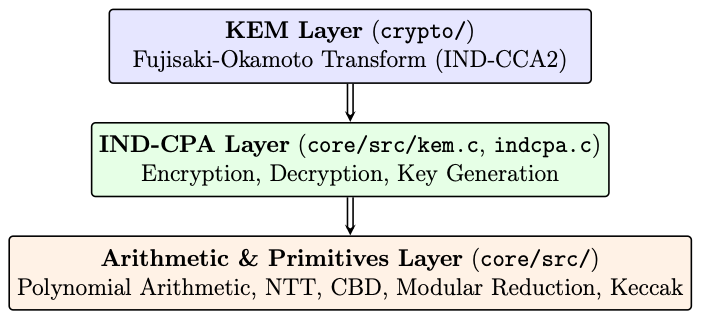
A Module-LWE-based key-encapsulation library written in C11. The implementation separates the public KEM API, the underlying public-key encryption scheme, and the arithmetic primitives into three layers.
Implementation focus
- Polynomial arithmetic and an in-place, seven-layer Number Theoretic Transform.
- Division-free Montgomery and Barrett reduction, with 32-byte-aligned polynomial storage.
- A C baseline and compile-time AVX2/AVX-512 variants for polynomial addition and subtraction.
- Constant-time ciphertext verification and conditional key selection.
Testing and validation
Catch2 tests cover arithmetic primitives, NTT roundtrips, sampling, hashes, encryption, and KEM roundtrips. An interoperability test encapsulates with libmlwe-fast and decapsulates with the official Kyber-512 reference implementation, comparing the shared secrets byte-for-byte.
A research project, not an independently audited or certified cryptographic library. The thesis validates against Kyber-512; final ML-KEM (FIPS 203) conformance is not claimed here.
Thesis benchmarks
Reported results on an AMD Ryzen 9 7900, with 5,000 samples per configuration using Catch2. GCC 16.1.1; release builds with -O3 -march=native -mtune=native -DNDEBUG.
| Operation | Reference (µs) | C baseline (µs) | Speedup |
|---|---|---|---|
| Key generation | 20.36 | 12.72 | 1.60× |
| Encapsulation | 24.22 | 12.06 | 2.01× |
| Decapsulation | 32.15 | 15.56 | 2.07× |
Mean execution times; lower is better. Source: thesis Table 4.2, p. 38. These are measurements from one machine, not a general performance guarantee.
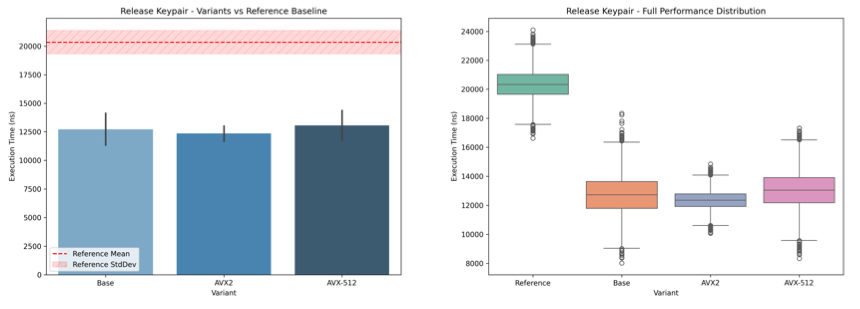
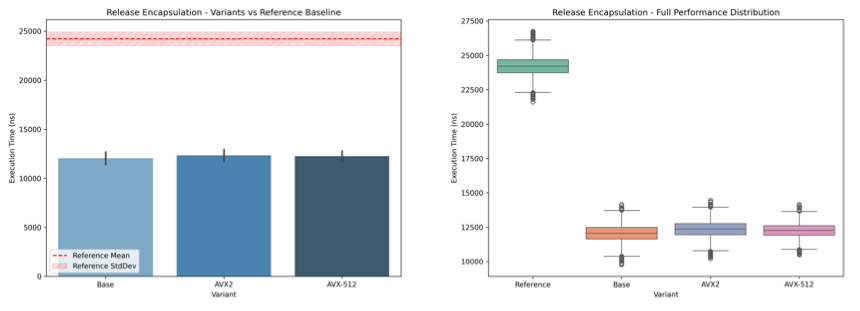
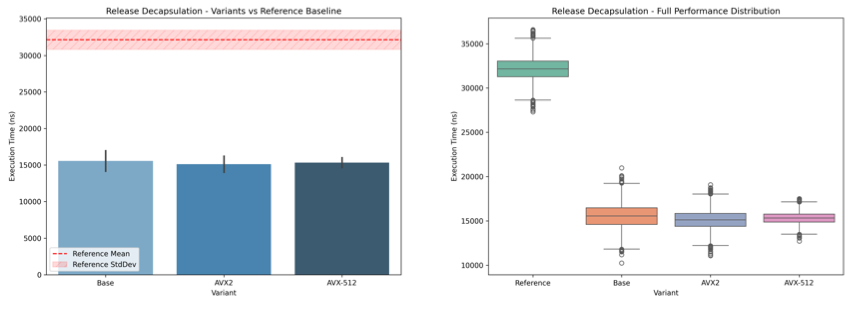
Manual AVX2 and AVX-512 paths brought only small additional gains, and sometimes slight slowdowns. They targeted polynomial addition and subtraction, while the more expensive NTT and hashing routines remained scalar. The analysis explores this limit through Amdahl’s law.